 |
PlantRegMap/PlantTFDB v5.0
Plant Transcription
Factor Database
|
| Home TFext BLAST Prediction Download Help About Links PlantRegMap |
Transcription Factor Information
| Basic Information? help Back to Top | |||||||||
|---|---|---|---|---|---|---|---|---|---|
| TF ID | Pbr030542.1 | ||||||||
| Organism | |||||||||
| Taxonomic ID | |||||||||
| Taxonomic Lineage |
cellular organisms; Eukaryota; Viridiplantae; Streptophyta; Streptophytina; Embryophyta; Tracheophyta; Euphyllophyta; Spermatophyta; Magnoliophyta; Mesangiospermae; eudicotyledons; Gunneridae; Pentapetalae; rosids; fabids; Rosales; Rosaceae; Maloideae; Maleae; Pyrus
|
||||||||
| Family | ERF | ||||||||
| Protein Properties | Length: 230aa MW: 25702.4 Da PI: 4.5887 | ||||||||
| Description | ERF family protein | ||||||||
| Gene Model |
|
||||||||
| Signature Domain? help Back to Top | |||||||
|---|---|---|---|---|---|---|---|
| No. | Domain | Score | E-value | Start | End | HMM Start | HMM End |
| 1 | AP2 | 58.6 | 1.5e-18 | 89 | 139 | 2 | 55 |
          AP2   2 gykGVrwdkkrgrWvAeIrdpsengkrkrfslgkfgtaeeAakaaiaarkkleg 55
                   y+GVr+++ +g+++AeIrd + ng   r++lg+f++ae Aa a+++a+ +++g
  Pbr030542.1  89 SYRGVRRRP-WGKFAAEIRDSTRNG--IRVWLGTFDSAEAAALAYDQAAFSMRG 139
                  69*******.**********44465..*************************98 PP
| |||||||
| Protein Features ? help Back to Top | ||||||
|---|---|---|---|---|---|---|
| Database | Entry ID | E-value | Start | End | InterPro ID | Description |
| CDD | cd00018 | 7.18E-20 | 88 | 148 | No hit | No description |
| PROSITE profile | PS51032 | 23.156 | 89 | 147 | IPR001471 | AP2/ERF domain |
| SuperFamily | SSF54171 | 2.55E-22 | 89 | 149 | IPR016177 | DNA-binding domain |
| SMART | SM00380 | 1.6E-37 | 89 | 153 | IPR001471 | AP2/ERF domain |
| Pfam | PF00847 | 2.5E-13 | 89 | 139 | IPR001471 | AP2/ERF domain |
| Gene3D | G3DSA:3.30.730.10 | 3.9E-30 | 89 | 148 | IPR001471 | AP2/ERF domain |
| PRINTS | PR00367 | 6.1E-13 | 90 | 101 | IPR001471 | AP2/ERF domain |
| PRINTS | PR00367 | 6.1E-13 | 129 | 149 | IPR001471 | AP2/ERF domain |
| Gene Ontology ? help Back to Top | ||||||
|---|---|---|---|---|---|---|
| GO Term | GO Category | GO Description | ||||
| GO:0006355 | Biological Process | regulation of transcription, DNA-templated | ||||
| GO:0006952 | Biological Process | defense response | ||||
| GO:0009873 | Biological Process | ethylene-activated signaling pathway | ||||
| GO:0003677 | Molecular Function | DNA binding | ||||
| GO:0003700 | Molecular Function | transcription factor activity, sequence-specific DNA binding | ||||
| Sequence ? help Back to Top |
|---|
| Protein Sequence Length: 230 aa Download sequence Send to blast |
MNYSIFDPPN SNLSPESSFG SSFSWDDGLK FGNNSLPFNE NDSEEMLLYG LISEATQEIT 60 SSVSVSANPI KEEEVSSAFE EENLKEEKSY RGVRRRPWGK FAAEIRDSTR NGIRVWLGTF 120 DSAEAAALAY DQAAFSMRGS TAILNFPVER VRESLREINY GTSDFGGCSP VMALKRKHSM 180 RRKTGFKKSK VDRDVRIENV VVFEDLGVDY LEELLNSTEN TSTSATPNW* |
| 3D Structure ? help Back to Top | ||||||
|---|---|---|---|---|---|---|
| PDB ID | Evalue | Query Start | Query End | Hit Start | Hit End | Description |
| 5wx9_A | 7e-29 | 86 | 149 | 11 | 74 | Ethylene-responsive transcription factor ERF096 |
| Search in ModeBase | ||||||
| Functional Description ? help Back to Top | ||||||
|---|---|---|---|---|---|---|
| Source | Description | |||||
| UniProt | Acts as a transcriptional activator. Binds to the GCC-box pathogenesis-related promoter element. Involved in the regulation of gene expression during the plant development, and/or mediated by stress factors and by components of stress signal transduction pathways. Seems to be a key integrator of ethylene and jasmonate signals in the regulation of ethylene/jasmonate-dependent defenses. Can mediate resistance to necrotizing fungi (Botrytis cinerea and Plectosphaerella cucumerina) and to soil borne fungi (Fusarium oxysporum conglutinans and Fusiarium oxysporum lycopersici), but probably not to necrotizing bacteria (Pseudomonas syringae tomato). {ECO:0000269|PubMed:11950980, ECO:0000269|PubMed:12060224, ECO:0000269|PubMed:12509529, ECO:0000269|PubMed:15242170, ECO:0000269|PubMed:9851977}. | |||||
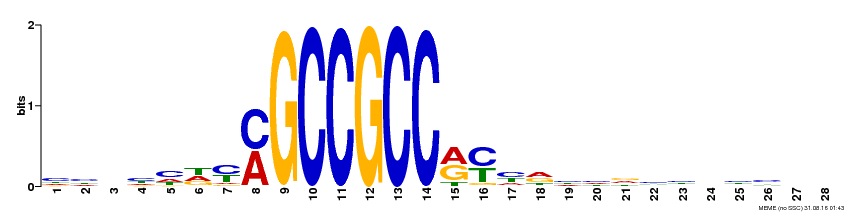
| Binding Motif ? help Back to Top | |||
|---|---|---|---|
| Motif ID | Method | Source | Motif file |
| MP00374 | DAP | Transfer from AT3G23240 | Download |
| |||
| Cis-element ? help Back to Top | |
|---|---|
| Source | Link |
| PlantRegMap | Pbr030542.1 |
| Regulation -- Description ? help Back to Top | ||||||
|---|---|---|---|---|---|---|
| Source | Description | |||||
| UniProt | INDUCTION: Induced by Pseudomonas syringae tomato (both virulent and avirulent avrRpt2 strains), independently of PAD4. Ethylene induction is completely dependent on functional ETHYLENE-INSENSITIVE2 (EIN2), ETHYLENE-INSENSITIVE3 (EIN3), which is itself a transcription factor and CORONATIVE-INSENSITIVE1 (COI1) proteins. Induction by jasmonate, B.cinerea or F.oxysporum as well as the synergistic induction by ethylene and jasmonate requires EIN2 and COI1. Induction by methyl jasmonate (MeJA) is independent of JAR1. Induction by salicylic acid (SA) is dependent on NPR1 but not on PAD4. Seems not to be induced by Alternaria brassicicola. {ECO:0000269|PubMed:11950980, ECO:0000269|PubMed:12060224, ECO:0000269|PubMed:12509529, ECO:0000269|PubMed:12805630, ECO:0000269|PubMed:15242170, ECO:0000269|PubMed:9851977}. | |||||
| Regulation -- PlantRegMap ? help Back to Top | ||||||
|---|---|---|---|---|---|---|
| Source | Upstream Regulator | Target Gene | ||||
| PlantRegMap | - | Retrieve | ||||
| Annotation -- Nucleotide ? help Back to Top | ||||||
|---|---|---|---|---|---|---|
| Source | Hit ID | E-value | Description | |||
| GenBank | GU732453 | 0.0 | GU732453.2 Malus x domestica AP2 domain class transcription factor (AP2D29) mRNA, complete cds. | |||
| Annotation -- Protein ? help Back to Top | |||||||
|---|---|---|---|---|---|---|---|
| Source | Hit ID | E-value | Description | ||||
| Refseq | XP_009339611.1 | 1e-168 | PREDICTED: ethylene-responsive transcription factor 1B-like | ||||
| Swissprot | Q8LDC8 | 8e-83 | ERF92_ARATH; Ethylene-responsive transcription factor 1B | ||||
| TrEMBL | A0A498HLK6 | 1e-145 | A0A498HLK6_MALDO; Uncharacterized protein | ||||
| STRING | XP_009339611.1 | 1e-167 | (Pyrus x bretschneideri) | ||||
| Orthologous Group ? help Back to Top | |||
|---|---|---|---|
| Lineage | Orthologous Group ID | Taxa Number | Gene Number |
| Fabids | OGEF311 | 33 | 199 |
| Best hit in Arabidopsis thaliana ? help Back to Top | ||||||
|---|---|---|---|---|---|---|
| Hit ID | E-value | Description | ||||
| AT3G23240.1 | 1e-72 | ethylene response factor 1 | ||||
| ©2010-2022, Center
for Bioinformatics, Peking University Last Modified: 2022-12-08 Questions or Comments, please contact  |
Supported By



|