| Signature Domain? help Back to Top |
 |
| No. |
Domain |
Score |
E-value |
Start |
End |
HMM Start |
HMM End |
| 1 | SRF-TF | 86.7 | 1.3e-27 | 3 | 52 | 2 | 51 |
                     ---SHHHHHHHHHHHHHHHHHHHHHHHHHHT-EEEEEEE-TTSEEEEEE- CS
           SRF-TF  2 rienksnrqvtfskRrngilKKAeELSvLCdaevaviifsstgklyeyss 51
                     rie  + rqvtfskRr g+lKKA+ELSvLCdaeva+++fs++g+lye++s
  TRIUR3_18962-P1  3 RIETPRSRQVTFSKRRGGLLKKAFELSVLCDAEVALVVFSPRGRLYEFAS 52
                     89999*******************************************86 PP
|
| 3D Structure ? help Back to Top |
 |
| PDB ID |
Evalue |
Query Start |
Query End |
Hit Start |
Hit End |
Description |
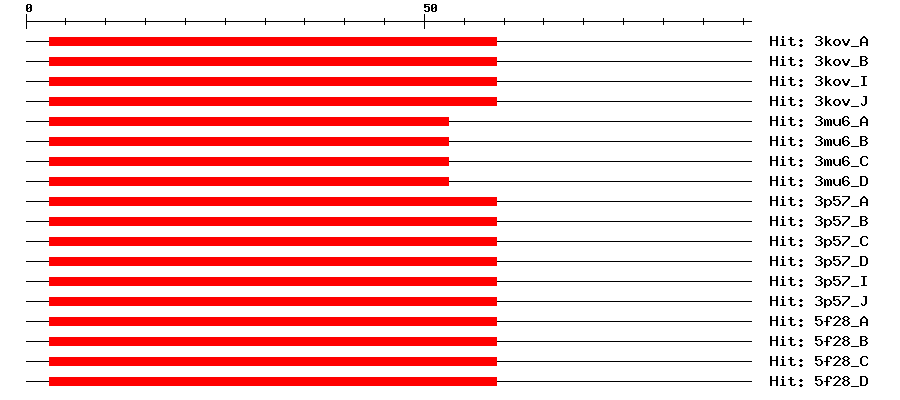
| 3kov_A | 9e-17 | 3 | 59 | 9 | 65 | Myocyte-specific enhancer factor 2A |
| 3kov_B | 9e-17 | 3 | 59 | 9 | 65 | Myocyte-specific enhancer factor 2A |
| 3kov_I | 9e-17 | 3 | 59 | 9 | 65 | Myocyte-specific enhancer factor 2A |
| 3kov_J | 9e-17 | 3 | 59 | 9 | 65 | Myocyte-specific enhancer factor 2A |
| 3mu6_A | 7e-17 | 3 | 53 | 9 | 59 | Myocyte-specific enhancer factor 2A |
| 3mu6_B | 7e-17 | 3 | 53 | 9 | 59 | Myocyte-specific enhancer factor 2A |
| 3mu6_C | 7e-17 | 3 | 53 | 9 | 59 | Myocyte-specific enhancer factor 2A |
| 3mu6_D | 7e-17 | 3 | 53 | 9 | 59 | Myocyte-specific enhancer factor 2A |
| 3p57_A | 9e-17 | 3 | 59 | 9 | 65 | Myocyte-specific enhancer factor 2A |
| 3p57_B | 9e-17 | 3 | 59 | 9 | 65 | Myocyte-specific enhancer factor 2A |
| 3p57_C | 9e-17 | 3 | 59 | 9 | 65 | Myocyte-specific enhancer factor 2A |
| 3p57_D | 9e-17 | 3 | 59 | 9 | 65 | Myocyte-specific enhancer factor 2A |
| 3p57_I | 9e-17 | 3 | 59 | 9 | 65 | Myocyte-specific enhancer factor 2A |
| 3p57_J | 9e-17 | 3 | 59 | 9 | 65 | Myocyte-specific enhancer factor 2A |
| 5f28_A | 1e-16 | 3 | 59 | 10 | 66 | MEF2C |
| 5f28_B | 1e-16 | 3 | 59 | 10 | 66 | MEF2C |
| 5f28_C | 1e-16 | 3 | 59 | 10 | 66 | MEF2C |
| 5f28_D | 1e-16 | 3 | 59 | 10 | 66 | MEF2C |
| Search in ModeBase |
| Publications
? help Back to Top |
- Rice Chromosome 10 Sequencing Consortium
In-depth view of structure, activity, and evolution of rice chromosome 10.
Science, 2003. 300(5625): p. 1566-9
[PMID:12791992] - Kikuchi S, et al.
Collection, mapping, and annotation of over 28,000 cDNA clones from japonica rice.
Science, 2003. 301(5631): p. 376-9
[PMID:12869764] - Thomson MJ,Edwards JD,Septiningsih EM,Harrington SE,McCouch SR
Substitution mapping of dth1.1, a flowering-time quantitative trait locus (QTL) associated with transgressive variation in rice, reveals multiple sub-QTL.
Genetics, 2006. 172(4): p. 2501-14
[PMID:16452146] - Park SJ, et al.
Rice Indeterminate 1 (OsId1) is necessary for the expression of Ehd1 (Early heading date 1) regardless of photoperiod.
Plant J., 2008. 56(6): p. 1018-29
[PMID:18774969] - Lee S,Jeong DH,An G
A possible working mechanism for rice SVP-group MADS-box proteins as negative regulators of brassinosteroid responses.
Plant Signal Behav, 2008. 3(7): p. 471-4
[PMID:19704489] - Maas LF,McClung A,McCouch S
Dissection of a QTL reveals an adaptive, interacting gene complex associated with transgressive variation for flowering time in rice.
Theor. Appl. Genet., 2010. 120(5): p. 895-908
[PMID:19949767] - Sun C, et al.
The histone methyltransferase SDG724 mediates H3K36me2/3 deposition at MADS50 and RFT1 and promotes flowering in rice.
Plant Cell, 2012. 24(8): p. 3235-47
[PMID:22892321] - Choi SC, et al.
Trithorax group protein Oryza sativa Trithorax1 controls flowering time in rice via interaction with early heading date3.
Plant Physiol., 2014. 164(3): p. 1326-37
[PMID:24420930] - Núñez-López L,Aguirre-Cruz A,Barrera-Figueroa BE,Peña-Castro JM
Improvement of enzymatic saccharification yield in Arabidopsis thaliana by ectopic expression of the rice SUB1A-1 transcription factor.
PeerJ, 2015. 3: p. e817
[PMID:25780769] - Jin J, et al.
MORF-RELATED GENE702, a Reader Protein of Trimethylated Histone H3 Lysine 4 and Histone H3 Lysine 36, Is Involved in Brassinosteroid-Regulated Growth and Flowering Time Control in Rice.
Plant Physiol., 2015. 168(4): p. 1275-85
[PMID:25855537] - Liu X, et al.
Brassinosteroid (BR) biosynthetic gene lhdd10 controls late heading and plant height in rice (Oryza sativa L.).
Plant Cell Rep., 2016. 35(2): p. 357-68
[PMID:26518431] - Hwang YH, et al.
Functional conservation of rice OsNF-YB/YC and Arabidopsis AtNF-YB/YC proteins in the regulation of flowering time.
Plant Cell Rep., 2016. 35(4): p. 857-65
[PMID:26754793] - Bai Z, et al.
The impact and origin of copy number variations in the Oryza species.
BMC Genomics, 2016. 17: p. 261
[PMID:27025496] - Shibaya T, et al.
Hd18, Encoding Histone Acetylase Related to Arabidopsis FLOWERING LOCUS D, is Involved in the Control of Flowering Time in Rice.
Plant Cell Physiol., 2016. 57(9): p. 1828-38
[PMID:27318280] - Alter P, et al.
Flowering Time-Regulated Genes in Maize Include the Transcription Factor ZmMADS1.
Plant Physiol., 2016. 172(1): p. 389-404
[PMID:27457125] - Han Z,Zhang B,Zhao H,Ayaad M,Xing Y
Genome-Wide Association Studies Reveal that Diverse Heading Date Genes Respond to Short and Long Day Lengths between Indica and Japonica Rice.
Front Plant Sci, 2016. 7: p. 1270
[PMID:27621738]
|